
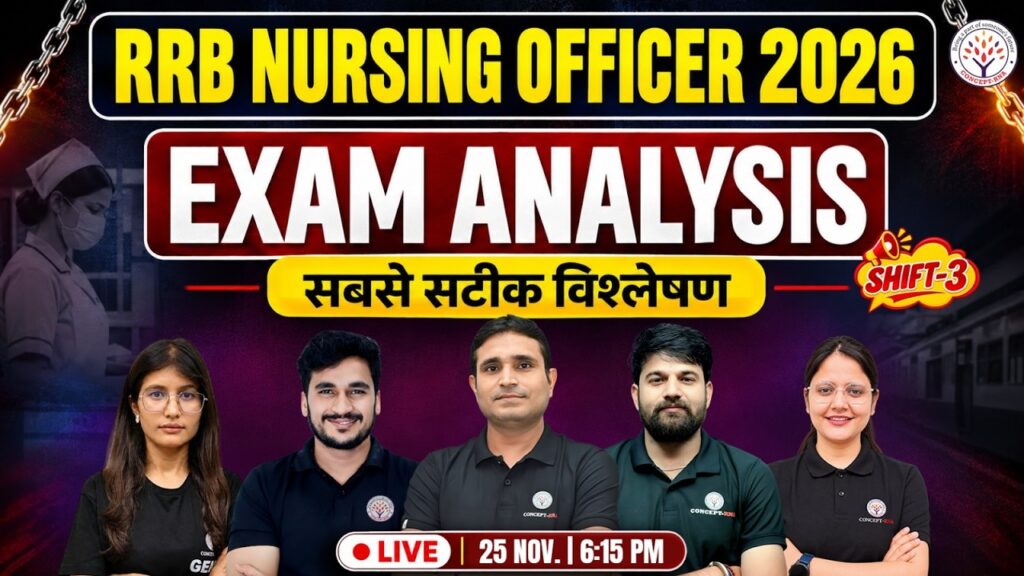
The RRB Nursing Superintendent exam analysis 2026 for Shift 3 on 25 November shows a moderate paper that looked quite different from the earlier shifts. Paediatric nursing (at least 14 questions) and community health nursing (12 to 13 questions) dominated, nursing research and management had good weight, and medical-surgical nursing was almost absent. The non-nursing section was the easiest of the day. This guide covers the memory-based questions with answers, a comparison of all three shifts, attempts reported by candidates, and the cut-off outlook.
Last updated: 26 November 2026. Based on the Concept RNA live paper discussion of the RRB Nursing Superintendent (CEN 05/2026) CBT held on 25 November 2026, Shift 3, including a live phone interview with a Kolkata zone candidate and questions shared by candidates. Questions are memory-based, so wording may differ slightly from the actual paper.
Quick answer: RRB Nursing Superintendent 2026 Shift 3 (25 November) was moderate, with an easy non-nursing section. Paediatrics and CHN carried about 26 to 27 of the 70 nursing questions. Key questions covered the first action for a newborn who is not breathing (clear the airway), primitive reflexes, the APGAR score, demography and the MMR formula, levels of prevention, MDG 6, the Panchayati Raj system, the Pap smear, menopause hormones, pre-eclampsia, glassware in the blue bin, the spleen and Mycobacterium tuberculosis. In the non-nursing section, questions covered GST (2017), the Pushkar fair, Desert National Park (Jaisalmer) and ethanol with sodium. One candidate attempted 82 questions.
Watch the full Shift 3 paper analysis
Sagar Sir analysed Shift 3 live, right after the paper, with candidates calling in and sharing questions. Watch the session below, then use the written breakdown for revision.
Other shifts on the same day: 25 November Shift 1 analysis and 25 November Shift 2 analysis.
RRB Nursing Superintendent 25 November Shift 3 at a glance
| Item | Details |
|---|---|
| Recruitment | RRB Paramedical Categories, CEN 05/2026 (365 Nursing Superintendent posts) |
| Shift analysed | 25 November 2026, Shift 3 (evening) |
| Paper | 100 questions, 100 marks, 90 minutes, one-third negative marking |
| Overall difficulty | Moderate |
| Nursing section | Moderate, with mostly scenario-based fundamentals questions |
| Non-nursing section | Easy (2 to 3 simple percentage questions; direct GA) |
| Highest weight | Paediatrics (at least 14), CHN (12 to 13), research and management |
| Lowest weight | Medical-surgical nursing (a candidate reported none), no PPH question |
| Attempts reported | One Kolkata zone candidate attempted 82 questions |
Exam rules, sections and syllabus are explained in our RRB Nursing Superintendent exam pattern and syllabus guide. Dates and result updates are on the RRB Nursing Superintendent notification 2026 page.
All three shifts compared: 25 November 2026
| Shift | Overall level | Non-nursing | What stood out |
|---|---|---|---|
| Shift 1 (morning) | Moderate | Moderate, time-consuming | OBG-heavy: stages of labour, PPH, ANC; also folic acid, cold chain, BMW and hand hygiene |
| Shift 2 (afternoon) | Easy to moderate (nursing) | Lengthy, calculation-heavy | CHN, labour, family planning, coeliac disease, GCS, health education |
| Shift 3 (evening) | Moderate | Easy | Paediatrics (14 or more), CHN (12 to 13), demography (3), research and management; almost no medical-surgical nursing |
The common thread across all three shifts was clear: community health nursing held its weight in every paper. Many candidates had prepared mainly for medical-surgical nursing and microbiology, but contraception, demography, labour and infection prevention recurred across shifts. Faculty takeaway for future RRB, NORCET and state exams: never treat CHN as a light subject.
RRB Nursing Superintendent Shift 3 questions with answers (memory-based)
Community health nursing, demography and administration
- Demography (3 questions) and MMR: India measures maternal mortality as maternal deaths per 100,000 (1 lakh) live births. MMR = (maternal deaths in a year ÷ live births in the same year) × 1,00,000.
- NHM: Act or programme? The National Health Mission is an executive programme (mission), not a statute. It was formed in 2013 by bringing together the NRHM (2005) and the NUHM (2013).
- Levels of prevention (Leavell and Clark): primary prevention covers health promotion and specific protection (for example immunisation). Secondary prevention is early diagnosis and prompt treatment (for example screening). Tertiary prevention is disability limitation and rehabilitation.
- MDG 6: combat HIV/AIDS, malaria and other diseases. Under the Sustainable Development Goals, this continues as SDG 3 (target 3.3).
- Panchayati Raj (2 questions): a three-tier structure of Gram Panchayat, Panchayat Samiti and Zila Parishad. It was recommended by the Balwant Rai Mehta Committee (1957) and given constitutional status by the 73rd Amendment (1992).
- Health planning committees: Bhore Committee (1946: integrated preventive and curative care, PHC concept), Mudaliar Committee (1962: consolidation of PHCs), and others.
- Food safety: FSSAI (under the Food Safety and Standards Act, 2006) sets Indian food standards, in line with international Codex standards developed by the WHO and FAO.
- Contraception for a newly married couple: a spacing method such as combined oral contraceptive pills (if there is no contraindication) or condoms, chosen after counselling.
- Role of the nurse in family planning: education and counselling for informed choice, clearing misconceptions, motivation and follow-up.
- Disaster: a scenario question on the impact of a major flood on the environment and on hospital services.
Revise with our community health nursing notes and national health programmes notes.
Paediatric nursing and newborn care (14 or more questions)
- Newborn not breathing or not responding at birth: first action: the initial steps of resuscitation come first. Keep the baby warm, position the head slightly extended, clear the airway (mouth, then nose) if needed, dry and stimulate. Then assess breathing and heart rate. If the baby is still not breathing, start bag-and-mask ventilation within the Golden Minute. Airway clearance comes before a detailed assessment.
- Primitive reflexes (2 questions): the Moro reflex disappears by about 4 to 6 months, the rooting reflex by about 4 months, the palmar grasp by about 3 to 4 months, and the Babinski reflex by about 12 to 24 months.
- APGAR score: appearance (colour), pulse, grimace (reflex irritability), activity (tone) and respiration, each scored 0 to 2. A score of 7 to 10 is normal, 4 to 6 moderate depression, and 0 to 3 severe depression. Practise calculating it from a given scenario.
- Growth and development: motor milestones, dentition and psychosocial development. Know the expected ages for head control (3 months), sitting without support (6 to 8 months), walking (12 to 15 months) and the first tooth (6 to 7 months).
Revise with our paediatric nursing notes.
Obstetrics and gynaecology
- Pap smear: cells are collected from the transformation zone (squamocolumnar junction) of the cervix to screen for cervical precancer and cancer. Avoid collecting during menstruation.
- Hormones in menopause: FSH and LH rise, while oestrogen and progesterone fall.
- HIV-positive mother (PPTCT): the mother continues lifelong antiretroviral therapy, the baby gets antiretroviral prophylaxis (syrup nevirapine) from birth as per NACO guidelines, and infant feeding is counselled.
- Pre-eclampsia: blood pressure of 140/90 mmHg or more after 20 weeks of pregnancy, with proteinuria or signs of organ involvement.
- Also asked: mechanism of labour, placental development and vaginal infections. PPH was not asked in this shift.
Revise with our obstetrics and gynaecology nursing notes.
Fundamentals, communication and nursing management
- Water spilt on the ward floor: patient safety comes first. Warn patients and keep them away from the wet area or put up a caution sign, then get it cleaned (inform housekeeping).
- A nurse explains a procedure using medical jargon the patient cannot understand: this is a semantic or language barrier to communication. Use simple, clear language and check that the patient has understood.
- Hand hygiene: the single most effective way to break the chain of infection.
- BMW blue bin: glassware, including broken or discarded glass, vials and ampoules, and metallic body implants. It must be a puncture-proof, leak-proof box with the blue colour marking.
- Burns: a first-degree (superficial) burn involves only the epidermis. A second-degree (partial thickness) burn involves the epidermis and part of the dermis, with blisters. A third-degree (full thickness) burn destroys both layers and may be painless.
- Management and education: decision-making in ward management and simulation as a teaching method in nursing education.
Related notes: fundamentals of nursing notes and first aid and emergency nursing notes (burns and disaster).
Anatomy, physiology, microbiology and pharmacology
- Spleen: called the graveyard of RBCs, because it removes old and damaged red blood cells.
- Plasma vs RBCs: plasma transports nutrients, hormones and clotting factors and maintains oncotic pressure. RBCs carry oxygen and carbon dioxide via haemoglobin.
- Thymus: the site where T lymphocytes mature.
- Causative organism of tuberculosis: Mycobacterium tuberculosis, an acid-fast bacillus discovered by Robert Koch in 1882.
- Vitamin A deficiency: night blindness is the earliest symptom, followed by xerophthalmia and Bitot’s spots.
- Pancreas: exocrine enzymes (amylase, lipase, trypsin) and endocrine hormones (insulin, glucagon).
- Immunity from vaccination: artificially acquired active immunity. Immunity after recovering from an infection is naturally acquired active immunity.
- Penicillin: do a sensitivity (test dose) check as per hospital policy and keep emergency drugs ready for anaphylaxis.
- Psychology and sociology: the introvert personality (reserved, prefers solitude, inward-focused) and polygamy. Polygamy means having more than one spouse: polygyny is one husband with several wives, polyandry one wife with several husbands.
Related notes: anatomy and physiology notes, microbiology notes, nutrition notes and pharmacology notes.
Non-nursing questions: general awareness, science and maths
| Area | Question or topic | Answer or key point |
|---|---|---|
| Chemistry | Reaction of ethanol with sodium | Forms sodium ethoxide and releases hydrogen gas: 2C₂H₅OH + 2Na → 2C₂H₅ONa + H₂ |
| Economy | When was GST implemented? | 1 July 2017 |
| Culture | Pushkar fair | Annual camel and livestock fair at Pushkar, Ajmer district, Rajasthan, held around Kartik Purnima |
| Geography | Desert National Park | Jaisalmer (and Barmer), Rajasthan; known for the Great Indian Bustard |
| History | Green Revolution | High-yielding seed varieties from the 1960s; M.S. Swaminathan is called its father in India |
| Current affairs | National AI summit host city; recent Padma awardees | Revise the last 6 to 8 months of current affairs |
| Maths | 2 to 3 percentage questions | Simple, direct calculations |
Time management lessons from Shift 3
Several candidates said they ran out of time. One spent 80 minutes on nursing alone. Sagar Sir’s three rules:
- Nursing first, but with a time limit: finish the 70 nursing questions in 50 to 60 minutes, not 80.
- Do not get stuck on wording: mark unclear scenario questions and unfamiliar calculations for review, move on, and return later.
- Plan your non-nursing time: keep a fixed 20 to 25 minutes for the 30 general questions so they never become a last-minute rush.
Practise this split in full-length mocks in the RRB test series. The faculty also shared a reminder after a candidate in the morning shift was refused entry because of traffic: the reporting time and the gate-closing time are different. Reach the centre well before reporting time, because gates are not reopened for late arrivals.
Expected cut off and what happens next
Asked about category-wise cut offs (for example, an ST candidate in the Kolkata zone scoring 71), the faculty chose not to give a figure from one shift. The CBT ran across multiple shifts on 23 and 25 November, so the RRBs will normalise marks and then set zone-wise cut offs based on vacancies and the number of candidates. Our indicative ranges and score calculation method are in the Shift 1 analysis, and we will update them after the provisional answer key. The minimum qualifying marks are UR and EWS 40%, OBC (NCL) and SC 30%, and ST 25%.
Keep preparing with Concept RNA
- RRB Nursing Superintendent coaching and the RRB preparation strategy.
- Daily Champion Series classes on the Concept RNA YouTube channel at 11:00 AM, now moving to the next vacancies, including the Rajasthan staff nurse exam.
- Free nursing notes PDF and staff nurse books.
- Book a free demo class.
- Nursing Meet-Up Agra, 29 November 2026: meet Dinesh Sir and Rajesh Sir. Free entry and a free MCQ book for registered students.
Preparing for AIIMS next? Read the NORCET preparation strategy 2026. See all nursing exam analysis guides.
Frequently asked questions
How was the RRB Nursing Superintendent exam on 25 November 2026, Shift 3?
Shift 3 was moderate overall, with an easy non-nursing section. Paediatrics (at least 14 questions) and community health nursing (12 to 13 questions) dominated, and medical-surgical nursing was almost absent.
Which subject had the most questions in RRB Nursing Superintendent Shift 3?
Paediatric nursing had at least 14 questions, followed by community health nursing with 12 to 13 and three on demography. Nursing research and management also had good weight.
What is the first action for a newborn who is not breathing at birth?
Carry out the initial steps of resuscitation: keep the baby warm, position the head, clear the airway if needed, then dry and stimulate. If the baby is still not breathing, start bag-and-mask ventilation within the Golden Minute.
What goes in the blue bin under the BMW Rules 2016?
Glassware, such as broken or discarded glass, vials and ampoules, and metallic body implants, in a puncture-proof box with the blue marking.
How is the maternal mortality ratio (MMR) calculated?
MMR = (maternal deaths in a year ÷ live births in the same year) × 1,00,000, so it is expressed per 100,000 live births.
How many questions are good attempts in RRB Nursing Superintendent Shift 3?
One Kolkata zone candidate reported 82 attempts. Because the non-nursing section was easy, more attempts were possible, but accuracy matters more than numbers under one-third negative marking. Around 70 well-reasoned attempts remains a safe target.
Which shift of RRB Nursing Superintendent on 25 November was the easiest?
Shift 3 had the easiest non-nursing section, while Shift 2’s nursing section was rated easy to moderate. Overall, all three shifts were within the moderate range, and normalisation will adjust for differences in difficulty.